
Esports Betting vs Sports Betting: Key Differences Explained
The comparison comes up a lot: Is esports betting really the same as sports betting? On the surface, they look similar—predict outcomes, risk money, win (or lose) based on results. But once you dig deeper, the differences become clear.
And in some cases, esports betting doesn’t just mirror sports betting—it goes beyond it.
In this guide, we’ll break down exactly how esports betting compares to traditional sports betting, what each offers, and why more users are starting to explore alternatives that don’t rely on sportsbooks at all.
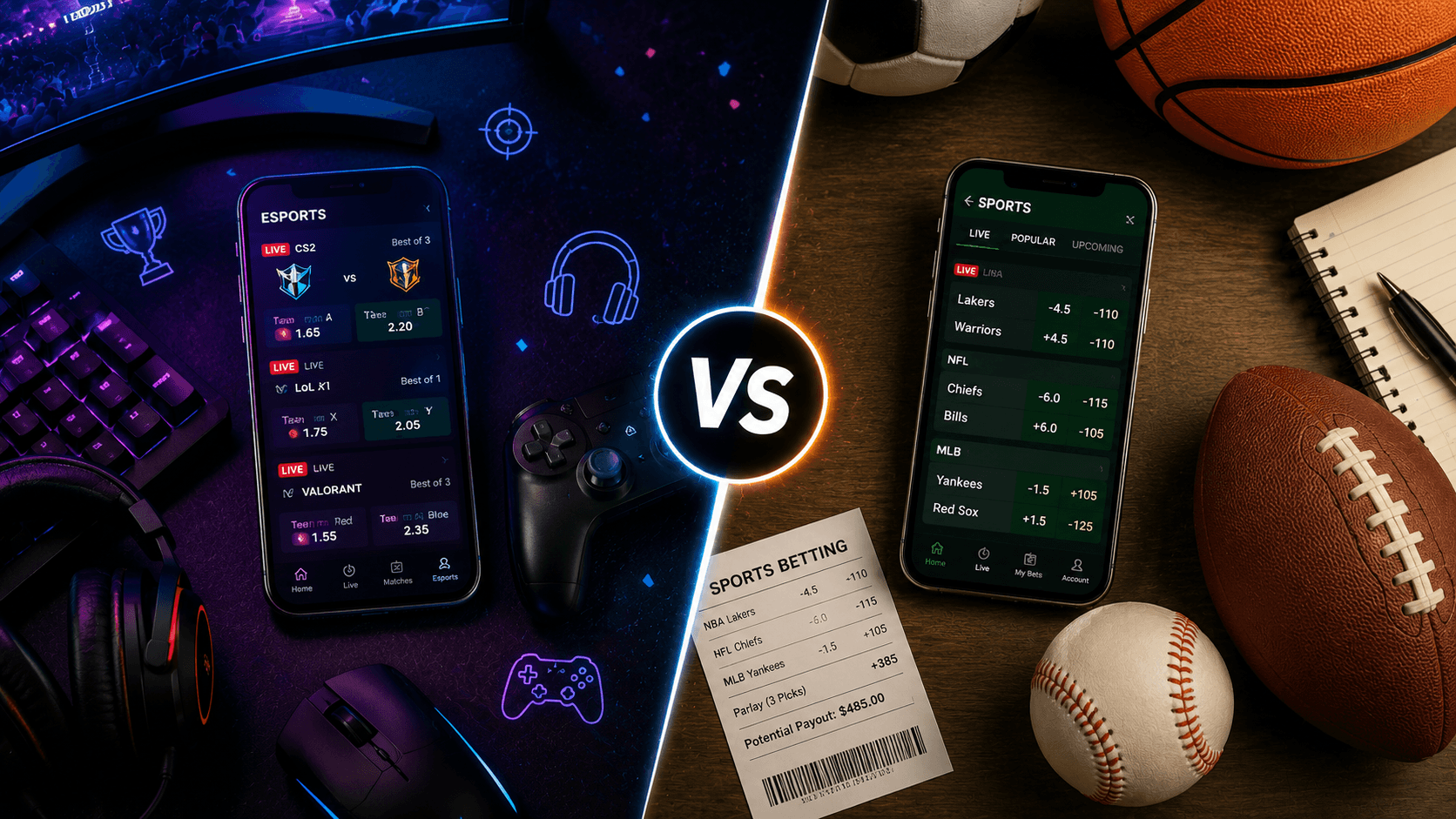
Esports Betting vs Sports Betting: Side-by-Side
At a high level, both esports betting and sports betting involve predicting outcomes. But the experience is very different depending on what you’re betting on.
Here’s a breakdown in list form:
Event Frequency
Sports betting: Scheduled games (NFL, NBA, etc.), often seasonal
Esports betting: Frequent matches, tournaments, and daily competitions
Game Types
Sports betting: Football, basketball, baseball, etc.
Esports betting: Titles like Call of Duty, Counter-Strike, NBA 2K, Madden, and fighting games
Betting Structure
Sports betting: Odds-based system controlled by sportsbooks
Esports betting: Similar structure, but with more volatility and niche markets
Esports staking: Player-backed prize pool system instead of sportsbook odds
Payout Speed
Sports betting: Can take hours or days, depending on the event
Esports betting: Often faster, especially for shorter matches
User Edge
Sports betting: Heavily modeled markets with sharp lines
Esports betting: Less efficient markets, especially in smaller scenes
Alternative Models (like staking)
Sports betting: Rare to nonexistent
Esports ecosystem: Growing fast with platforms like 1v1Me
The biggest takeaway? Esports betting may look like sports betting—but the ecosystem around it is evolving much faster.
What Esports Betting Offers That Sports Betting Doesn’t
Esports isn’t just a digital version of sports—it introduces entirely new dynamics.
First, there’s accessibility. Anyone who plays or watches games already understands the mechanics. You don’t need to learn new rules or stats—you already know how the game works.
Second, there’s speed. Matches can happen constantly, especially in online formats. You’re not waiting all week for a game—you can engage daily.
Third, there’s variety. Traditional sports have fixed formats. Esports can range from 1v1 fighting games to large-scale team shooters, each with different pacing and betting opportunities.
But the biggest difference is this:
Esports opens the door to models that don’t rely on sportsbooks at all.
That’s where staking stands out. Instead of betting into a system designed around odds and margins, you’re directly participating in the outcome of a match.
For many users, that feels more intuitive—and more engaging.
What Is Staking? (And Why It’s Different)
Before diving into comparisons, it’s worth understanding a newer model that’s often confused with esports betting: staking.
On platforms like 1v1Me, you’re not betting against a sportsbook. You’re backing a real player in a live matchup. Your stake goes into the match prize pool, and if your player wins, you receive your share of that pool.
No complicated odds. No long wait times. Just quick, head-to-head competition with fast results. And matches are live every 30 mins, 24/7, 365 days a year, on 1v1Me.
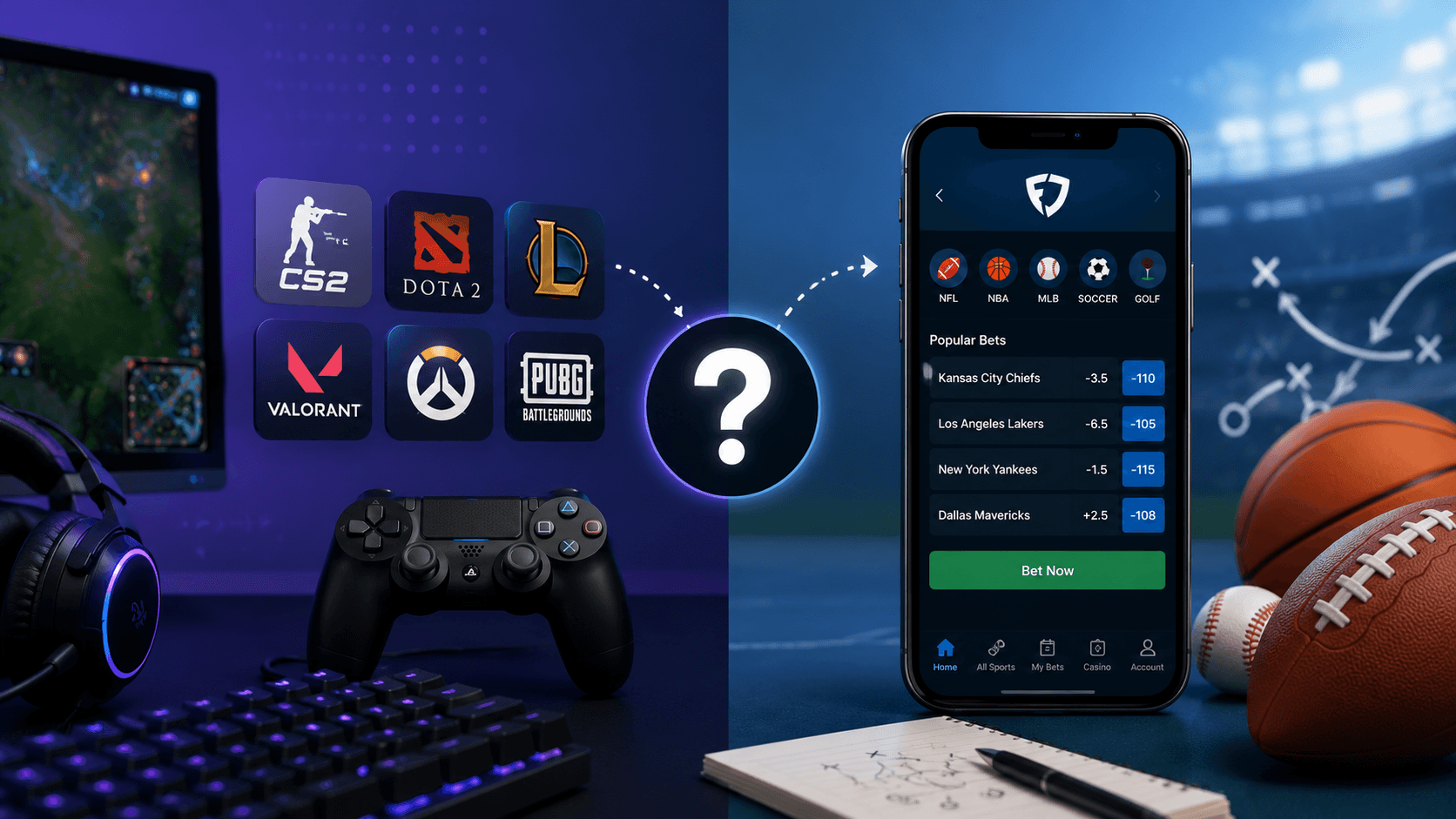
Is There a “FanDuel for Video Games”?
Platforms like FanDuel or DraftKings dominate traditional sports betting by offering easy-to-use apps, fast deposits, and a wide range of betting markets.
But when it comes to video games, the answer isn’t as straightforward.
There are esports betting sites that mimic sportsbooks. They offer odds, match lines, and similar interfaces—but they’re still fundamentally the same model.
What’s emerging instead is something closer to a true “FanDuel for video games,” but built differently. That’s where 1v1Me comes in.
Instead of acting as the house, it connects users directly to matches. Instead of odds, it uses prize pools. Instead of passive betting, it creates an active experience in which you back players in real time.
So while it’s not a sportsbook clone, it arguably delivers what people are actually looking for—a dedicated platform built specifically for gaming competition.
Why Sports Bettors Are Switching
A growing number of traditional sports bettors are exploring esports—and in many cases, moving beyond sportsbooks entirely.
Here’s why:
Faster Results
You don’t have to wait for a full game cycle. Many esports matches resolve quickly, especially on the 1v1Me platform.
More Action
There’s always something happening. No offseason, no downtime.
Knowledge Advantage
If you already play or watch a game, you often have a stronger read than you would in traditional sports markets.
Less Reliance on Odds
Platforms like 1v1Me remove the need to interpret betting lines, making the experience more straightforward.
More Engaging Experience
Instead of passively watching a bet play out, you’re actively backing a player in a live competition.
For some users, it’s not about replacing sports betting—it’s about finding something that feels more aligned with how they already engage with games.
FAQ: Esports Betting vs Sports Betting
Is esports betting like sports betting?
Yes, at a surface level, both involve predicting outcomes, but esports betting often moves faster, covers different types of games, and includes alternative models like staking.
Is there betting just for video games?
Yes. Esports betting platforms exist, and newer platforms like 1v1Me focus entirely on video game competitions and staking professional gamers.
Is there a FanDuel for video games?
Not in the exact same format. But 1v1Me is often described this way because it offers a streamlined, app-based experience built specifically for staking gaming.
What’s the difference between betting and staking?
Betting involves wagering against a sportsbook with odds. Staking involves backing a player in a live match and earning a share of the prize pool if they win.
Are there betting apps that aren’t sports betting?
Yes. Staking esports platforms like 1v1Me, prediction markets, and fantasy apps all offer alternatives to traditional sports betting.
Final Thoughts
Esports betting and sports betting may look similar on the surface, but they’re heading in very different directions.
Sports betting is built around sportsbooks, odds, and structured schedules.
Esports, on the other hand, is more flexible, more frequent, and increasingly more interactive.
And with platforms like 1v1Me introducing staking, the experience is shifting even further—from passive betting to active participation.
If you’re used to traditional sportsbooks, esports betting is a natural next step. But if you’re looking for something that feels faster, simpler, and more connected to the action, staking might be what you’re actually looking for.
Either way, the ecosystem is expanding—and it’s not slowing down anytime soon.
Author:
Jordan Kline
Jordan covers esports culture, gaming news, and how competitive scenes evolve across titles. He writes breakdowns that bridge mainstream gaming trends with the creator-driven world of 1v1Me.

15,000+ Ratings
